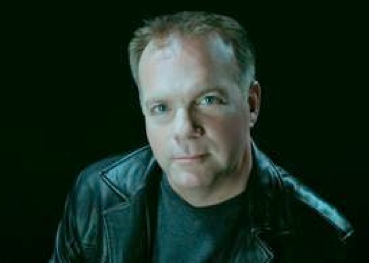
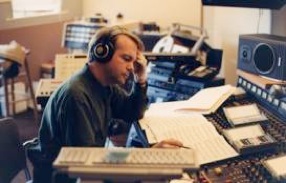
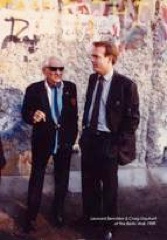
Craig Urquhart’s name isn’t too well known as yet, but he has had a very colorful musical life so far, and is creating original music on his own terms. His mother was the neighborhood piano teacher, so music was introduced and became a passion at a very early age. Craig was also enthralled by “Leonard Bernstein’s Young People’s Concerts” which were shown on television in the 1950’s, and while the other kids around him wanted to become police officers and football players, Craig wanted to be “just like Leonard Bernstein.” Right after college, Craig moved to New York City, and, on a lark, left some of his music with Leonard Bernstein’s doorman at The Dakota. The two became friends, and Craig eventually became Bernstein’s personal assistant for the last five years of his life (1985-1990). Craig is now working on his fifth CD of original pieces on his own label, “HeartEarth Music.” What follows is an interview we did by phone in April 2003.
KP: You said you started improvising at the age of six, when you discovered the black keys on the piano. Let’s talk about that.
Urquhart: I realized those five notes, which I call my “Chinese Music,” somehow resonated with me and made tonal sense. That’s what I started improvising on.
KP: Was your first piece, “Sonatina #1,” all on the black keys?
Urquhart: No, “Sonatina #1” is in A major. I’ve never done “Sonatina #2.”
KP: Since your mother was the local piano teacher, was she your teacher as well?
Urquhart: At the very beginning, but it didn’t work very well, and she had the sense to find me another teacher.
KP: My mom was my first teacher, too, and she always says that I got too cocky.
Urquhart: There is a mother/child dynamic that isn’t always positive.
KP: Especially in that kind of a role - you need somebody different.
Urquhart: That’s what I mean. You don’t need to add “piano teacher” to the list of things a mother has to be responsible for.
KP: Where did you go to college?
Urquhart: I went to the University of Michigan, and got my Masters Degree from there in 1976. Then I went to New York right away.
KP: What made you decide to leave some of your music with Leonard Bernstein’s doorman?
Urquhart: One of the reasons I moved to NY was Leonard Bernstein’s, “Young People’s Concerts,” which I had followed as a child. I remembered sitting and watching him, and wondering, “Why aren’t I there?” There were no opportunities like that where I was growing up [in Michigan]. There was no one with such charisma giving young people’s concerts. Somehow I just knew that that was where I wanted to be - in that kind of environment. So, I came to New York.
KP: How long after you arrived did you leave the music for Bernstein?
Urquhart: Oh, about four weeks.
KP: So you did it right away!
Urquhart: The first person I called when I came to New York was John Corigliano. I’d seen an article about him in a magazine, and thought, “There’s a young composer.” He’s about ten years older than I am, and he agreed to meet with me. He was very professional and nice, and got me hooked up into the music copying business, which was done by hand then. I did some work for an opera composer, and then I did a piece for John Corigliano, and then I realized that maybe music copying wasn’t where I should be. It was tedious, and I wasn’t that good at it. I just didn’t have the patience to be as good as what people needed. And thank God we have computers now - they make a life a lot easier! Although I stumbled around for a few months, I met people through that work, and that was good. Then I left this package of music at The Dakota for Leonard Bernstein. About six weeks later, his secretary called and said that Bernstein would like me to come to a concert. I went, and then met him backstage - it was really great! I worked for CF Peters [classical music publisher] through a connection with one of my teachers, and then I worked for Belwin Mills through another connection. In the meantime, I saw an ad in the newspaper asking for “an assistant to a major musical figure.” I decided to answer the ad, and it turned out to be for Leonard Bernstein. It’s interesting how fate is - I had just met him a couple of weeks before. I got a call from his manager, so I went over to be interviewed, and it was the first chance we’d had to talk about my music. Lenny said, “There seem to be two people here. There is somebody who writes beautiful songs, and there is somebody who writes this twelve-tone stuff.” My secret was out! I couldn’t hide my real musical language from him. He said, “You really need to write from the heart, and not from the head.” I had done all of the academic work - 12-tone, atonal, music where you draw cards and everyone improvises - and things like that, so I went back to the music that I wrote as a child, and went into the harmonic languages there. That’s what I built my music on after that - that sense of childhood tonality that I had. Anyway, the interview with Lenny went well. His manager, Harry Kraut, and I met, and Harry is still one of my dearest friends. He’s now the Executive Director of the Bernstein Organization. After the interview, it was mutually agreed that it wasn’t the right time for me to take the job as Lenny’s assistant. I had only been in New York for about six months, and I was suffering from culture shock. Here was a kid from the Midwest, who, when he came to NY only knew one person. A friend from college said “I’ve got a loft in Chinatown for two months, do you want to come and live with me?” Other than him, I didn’t know a soul. I’d never even smelled garlic on the street before! I really wanted to teach for awhile, and I just didn’t feel equipped emotionally or worldly-wise to take something like that on. Harry remained a very dear friend of mine, so I got to see a lot of Lenny, and we built a friendship. Then in the middle of 1985, Harry called and said they were looking for a new assistant - did I know of anybody who might want the job? I called back the next day and said that I would like the job, that now I was ready.
KP: So about ten years had elapsed?
Urquhart: Yes, I taught piano at The Harlem School for the Arts for about ten years. I taught piano, theory, and composition. With time and experience, I had a better feel for the world and for myself. When you are working with someone like Leonard Bernstein, you have to have an identity or you will lose it. The genius is so seductive that you want to be a part of it. You have to have a sense of your own self or you won’t be able to do the job. Lenny needed strong people around him.
KP: What were your duties as his assistant?
Urquhart: Everything from marking parts (he would travel with his own set of orchestral parts) to making sure he showed up for rehearsals, to being tour manager - just doing pretty much anything he needed to have done. Copying music, discussing as a confidante how well a performance went - a little bit of everything.
KP: Did you actually live in his apartment?
Urquhart: No, no, I wouldn’t do that. I had my own life.
KP: So it was basically just a job.
Urquhart: Yes. On the road, it would be Harry, Craig, and Lenny. We would all live in the same hotel, but not in New York.
KP: So it wasn’t like in the middle of the night, he would ring a bell and you had to go running. It was the business end of things.
Urquhart: Yes, and it was an amazing experience.
KP: It must have been very difficult when his health started to fail.
Urquhart: It was a very tough time. Especially after he died.
KP: How did Leonard Bernstein influence your music?
Urquhart: At the beginning, he asked, “Which music do you resonate with?” and I told him the tonal music, and I think that really set me free. That’s how he influenced it, and he was very supportive of that aspect of it. He wrote a letter that talks about “the deceptive simplicity” of my music. It is tonally somewhat simple, but there is a profoundness and a depth to the music that he really believed in. He said that my music should not be confused with what is currently being termed “new age music.” To quote Lenny’s letter: “It has a deceptive simplicity and honesty that is rarely to be heard in contemporary writing. His tonal approach is not merely sincere, but genuinely moving with a private beauty of its own.” It’s a nice statement from Leonard Bernstein.
KP: Who are some of your other influences?
Urquhart: Being a classically-trained pianist, I try to draw upon all of the history that I know. My “Klavierstucke” was almost an homage to Bach; my “Songs Without Words” obviously come from Mendelssohn. Debussy is one of my favorite composers - I think his writing is so skillful, and there is so much in it. I love Chopin, obviously, with my “Nocturnes”. Schumann is a great influence; I like to think of each of my albums as a complete work, sort of in a Schumann way. “Epitaphs and Portraits” is kind of a journey into the lives of the people I was memorializing. Writing that collection also helped me to grieve for Lenny. I was dealing with so much death around me, and to lose a mentor and a friend like Lenny was really devastating. I also love Joni Mitchell’s piano playing. And I thought Laura Nyro was a tremendous songwriter. I’ve also always really liked the music of Brian Eno, which is very atmospheric.
KP: Are there any other so-called new age pianist/composers that you listen to?
Urquhart: I used to listen to Keith Jarrett, but I don’t anymore. I like Philip Aaberg.
KP: He’s one of my favorites, too!
Urquhart: I try to not listen to too many others because I don’t want to be influenced by them. I consider myself to be a very serious composer, but a lot of people in the “serious circles” haven’t taken my music seriously. Fortunately, I’m finding that it’s beginning to change. It takes a certain amount of guts to be as honest in writing music as I am.
KP: It sounds like you’re still very involved in the classical realm.
Urquhart: I am, but I definitely like all kinds of music. Lenny was the ultimate crossover artist. Was he a classical composer? Was he a Broadway composer? A jazz composer? I like to write mostly for the piano, and that limits the exposure you get. For me, the piano is the ultimate instrument.
KP: Are you still affiliated with the Bernstein family?
Urquhart: We’re very close. We’re all neighbors.
KP: How much of your music is dedicated to Leonard Bernstein?
Urquhart: “The Dream of Flight”is dedicated to Lenny.There are some songs that I dedicated to him as well. One of the new things that I recently recorded is called “Birthday Notes CULBCU.” I wrote Lenny a piece of music, and he did a five-bar variation of it, so it’s sort of a piece we wrote together, which was really fun. In Lenny’s last set of piano pieces, “Thirteen Anniversaries,” one of the pieces is titled “For Craig Urquhart.” It’s really a nice little piece - a good teaching piece.
KP: Along with composing for piano, you’re known as a composer of “art songs.” What, exactly, does that mean?
Urquhart: I set texts of poetry to music in the Schubert/Ned Rorem kind of way. IÔve used texts by Walt Whitman, Emily Dickinson, Carl Sandburg, and DH Lawrence. My next big project, after I finish the recording I’m working on, is a song cycle. I have someone I especially want to write for now, and that always makes a difference. I also want to have a bigger output of songs. I think it’s a good time, with the way the world is, to unite various arts. For me, it’s one of the higher forms of art to unite poetry and music.
KP: Rather than just having someone write lyrics.
Urquhart: I would love to write a hit pop song. I did write one once called “Love Is Leonardo” for a book on Leonardo daVinci. Not Leonardo daVinci, Leonardo diCaprio! Excuse me, there is a difference! It was very “Titanic.” A friend of mine wrote the book, and she wrote some very funny lyrics that I set to music. It was included in the book.
KP: That didn’t hit #1, though, huh?
Urquhart: No, it didn’t!
KP: Well, at least you don’t have to live it down for the rest of your life!
Urquhart: Exactly!
KP: What did you do when you coached Tom Hulce for the role of Mozart in “Amadeus”?
Urquhart: We worked six-eight hours a day for about four weeks. I taught him how to play the piano.
KP: Did you teach him to conduct, too?
Urquhart: No, I think he studied conducting with Neville Mariner. He didn’t know how to play the piano, so I taught him that, and I taught him to play the pieces that he was to mimic in the movie. He learned the second movement of a Mozart concerto during that time - a very smart boy! He’d had some music background - he played guitar - but I started him with five-finger patterns around the circle of fifths, major and minor, you know, that whole thing. One of the stipulations of the role was that he had to be convincing that he was playing the pieces. They didn’t want to show Mozart playing the piano without showing his hands, and Tom wanted to be that person. It was kind of like lip-synching at the piano.
KP: What’s up next for you?
Urquhart: I’m working on a new album, which includes some new music called “Nocturnes.” It should be ready by early 2004.
KP: I hear you have two grand pianos?
Urquhart: Yes, I have the Baldwin I grew up with, a nice model R, and then I have this incredible Bosendorfer that was Bernstein’s in Vienna. That’s what I’ve done the last three recordings on.
KP: What’s the story behind HeartEarth Music?
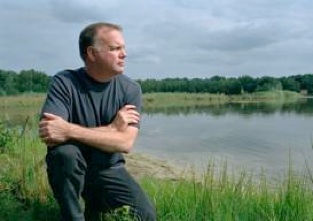
Urquhart: There is a reason that I call it that. I believe that the music that we hear and that we write can unite the heart and soul with the physical realities that we live in. I believe that most of my music comes from nature; the rhythms come from nature. The melodies come from nature. You take them in subconsciously - you hear bird songs, you hear these things all the time. The rhythms of water, of a stream; these are all a part of my sound world. It’s a soul-enhancer.
KP: Do you have to go very far from New York City to get into nature?
Urquhart: I go kayaking on the Hudson River, and there is a beach about forty minutes away. The Catskill Mountains are about an hour away. People think of New York City as a jungle, but even Central Park has some wonderful places of nature.
KP: If you could have any three wishes, what would they be?
Urquhart: For the world to live peacefully together, to obliterate greed, and to play Carnegie Hall.
KP: Do you have any words of advice for young people who are studying music now?
Urquhart: Enjoy it - have fun with it, don’t worry about being perfect. Try different styles - music can enrich ones life in ways no other discipline can, but the only way to progress is to do it daily.
Many thanks to Craig Urquhart for taking the time to share his life and music with us! Be sure to check out
his website and his
Artist Page here on MainlyPiano.com.
Kathy Parsons
June 2003