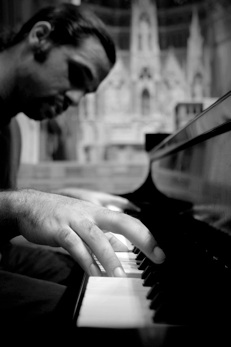
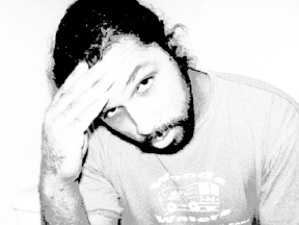
Pianist/composer Kenny Jaworski recently released his first CD, "A Piano Saga," which is generating a lot of buzz - especially in the classical music community. To say that this album is different would be a huge understatement. It is big, bold, edgy, and very personal. Kenny sent me a demo of his CD last year for review, and we began an email correspondence. I have been very impressed with his originality and sincerity, and have thoroughly enjoyed getting acquainted with this young artist early in his career.
The 27-year-old Jaworski is a lifelong resident of St. Louis, MO, and is the second of three sons. Both of Kenny's brothers are classical percussionists who live in Illinois and have a pop/folk group on the side called "The Mans." Kenny's dad plays the guitar and has written several songs, one of which was used on a local PBS station. His mom minored in dance in college and recently retired after thirty-three years as an elementary school teacher. She also writes children's stories, so the whole family is very creative.
This article comes mostly from a phone interview on May 9, 2006 and includes quotes from a couple of email messages.
KP: When did you start playing piano?
Jaworski: It's funny because I never said, "Okay, now I'm going to play piano." My main instrument for a long time was guitar. I went to college full-time for a couple of years, majoring in music, and during that time, I learned that music was me; I just hadn't found my niche yet. When I was twenty-one, I realized that I didn't need to work on other people's music; I needed to concentrate on writing music for myself. My first couple of concerts were a combination of solo piano and solo guitar. My first all-piano concert was at St. Francis Xavier College Church in 2004, where "A Piano Saga" was recorded the following year. It happened gradually and very naturally because that's where I was headed anyway.
KP: You did all of that on your own?
Jaworski: I've never had a piano teacher, but I've had a couple of guitar teachers off and on. It's been an uncharted course in terms of my musical development. It's been difficult, too - I've had some painful experiences along the way. Those have undoubtedly helped to fuel the emotional side of my music, but there are many times when I feel like I'm very much in a different category from other people.
KP: You're blazing your own trail.
Jaworski: Right. That's definitely what I want. I don't want to do something that's been done before, but that doesn't mean it's easy.
KP: If somebody asks you to describe your music, what do you say?
Jaworski: I tell them it's solo piano music, but that it's not like what they've heard. If they find other music to be dull and uninteresting, mine is not. Often there is a lot of speed and interesting rhythmic things happening, and sometimes there is a groove that you really wouldn't expect. I basically tell them that it's fresh and more exciting than what they might expect to hear with solo piano music. I also tell them to stop by the website and actually hear it. To be completely honest, I find most of what's out there to be not particularly interesting. I can get bored pretty easily, as you might imagine. This must be part of why there's so much action, energy, movement, and speed in a lot of what I do.
KP: Do you have a target audience?
Jaworski: That's an interesting question. I've done concerts at a grade school and a high school, and the students at both really ate it up. The concert where I recorded the album was for the state chapter of The Lupus Foundation. I didn't know until that night that there were going to be a lot of elderly people there. When I saw them, I was afraid they weren't going to like it. After the first half, I looked out in the audience, and there were all of these smiling faces and enthusiastic hands clapping. So, there doesn't really seem to be an age range. It would seem that people who are a bit more educated would be more likely to understand my music, but people from a lot of different persuasions seem to really get it and like it. It seems like the people who really like my music are at least partially responding to me, what I'm saying, and who I am. It's important to reach people, but that's a pretty complicated proposition because my music is really different. There are people of the highly cultured, classical school who really like me, and then there are people of that same school who don't, and sometimes it's for some of the same reasons. I don't really feel at home in any given classification, so it seems to be one of those things where you have to see and hear it; then you'll know if you like it.
KP: When I first started listening to your music, I assumed it was more in the jazz realm. I thought it was probably mostly improvised, but you said it's very structured. It makes sense that people who listen to 20th century classical music would understand yours, although you have some interesting rhythms that don't necessary show up in those composers' work. I probably listened to your CD a dozen times before I wrote anything, and we also had an interesting correspondence going. I can see why a live setting that allows people to get to know you would make a difference because the email messages really helped me understand the music and where you were coming from.
Jaworski: My music is definitely not improvised. There are embellishments here and there, depending on the piece, but not improvisations in the way they are generally regarded. This album was made by accident, really. We didn't plan to record an album that night, but it was something that I had had been moving towards for years. I was very fortunate to have picked a really good engineer, Chelsea VandeDrink. She said that when I got very loud and very fast, they watched the recording levels. I would get as close as I could possibly get to going over the top and sounding bad, and the level would kind of freeze and then slowly come back down. She said it really looked like God had his hand on that peak point! If you think about a concert where you saw an artist who performed incredibly well, capturing that on tape is one thing, but capturing it well is something else. Capturing an artist's introductory performance well is about as lucky as you can get. With this record, there is a very clear line of feeling because the pieces were all played on the same evening and mostly in the same sequence (tracks 3-6 were shifted around somewhat). The album is a very honest representation of me.
KP: It seems like your playing is extremely physical. How do you keep your arms and wrists in shape to prevent injury?
Jaworski: I don't really have any issues with my arms or wrists. The impact comes down mostly on the fingertips. That can be a bit of a problem sometimes and is probably the reason why I don't do very much playing. I know that sounds a little bit crazy, but I really don't spend much time practicing. That's partially because I've heard so many stories about people burning out, and I think it's good to keep a certain kind of freshness. Also, if I spent a lot of time practicing some of my music, my fingers would always be in not-so-great shape. The only problems I've had are a few times when I've been tired. That happened at this last show, and it was scary. I came out and played the first piece, "The First One," the opening track on the album. When I began the second piece, I started feeling really tired - tired enough to feel like I had to stop. It was a major test, but I was able to keep going, and I don't think anyone noticed. So, it's not really my arms so much as it is staying mentally focused. For a number of my pieces, I have to be in a space of trusting because if I'm consciously thinking of which notes to play next, I'm going to miss those notes. It's more of a mental thing than a physical thing.
KP: How often do you break piano strings?
Jaworski: That has happened twice, and they were both old, not-well-treated instruments. The first time was only a couple of years ago on my old piano. I was walking past it and hit the note, and it went "ping." The second time was last fall at the NAACP's banquet in Nashville. I was scheduled to play a piece and needed to get the feel of the instrument, but the piano tuner was taking a really long time. When I was finally able to try out the piano, I was pretty wound up and broke one of the higher strings. It's never happened with a really good piano.
KP: Your music is very dramatic. Does that mirror your personality?
Jaworski: My music certainly mirrors my life and how I see and feel things.
KP: Do you always have music in your head?
Jaworski: Yes. I constantly dream music and am usually hearing music in my waking hours as well. There are times when that will turn into something I can use, but that usually happens at the keyboard.
KP: How do you go about composing a piece?
Jaworski: What usually happens is that I'll come up with an idea, work on it, record it, listen to it, and try to come up with contrasting ideas. Basically, the goal is to come up with a piece that makes some type of true statement, and that's where structure is huge for me. The structure of a piece comes into play pretty early once I have an idea that I really like, but it usually takes a long time to complete a piece. A few pieces on the album took many months, but "Grace" was written as it was being played the first time.
KP: So that one was completely improvised?
Jaworski: Not in the show. The night that piece was written, I was working on something else and decided to take a break that went on for longer than I anticipated. When I finally came back, I was feeling pretty guilty about wasting that much time. I pressed "record," sat down at the piano, and just started to play. When I pressed "stop" and listened to it, I thought it had possibilities. After I listened to it three times, I thought, "That's the whole thing!"
KP: Do you actually write out any of your music?
Jaworski: Not while I'm writing it. There are a few things that I've scored long after the fact, but not while I'm composing. I can do it, but it just slows everything down. It's not my thing, but "The Mystique Factor" looks really cool on paper. There are people who really like to see their music written out, but I just like to hear it and know that it sounds good. .
KP: Do you read music?
Jaworski: I can do it, but I'm not a great sight-reader.
KP: Who do you consider to be musical influences?
Jaworski: There have been people from virtually every genre who have been influential. Some are from entirely different disciplines: singers, producers, authors, directors, screenwriters. The music that I listen to is in a two-hundred disc changer, and there are all kinds of music in there. I like people who make distinctive, individual statements. I think Bill Cosby is great. There's a film that he made in 1980 that's him doing standup, and it's as masterful a performance as you could see - and it's a very personal statement. Tom Green is pretty crazy, but it's a very personal and brave thing that he's doing. I think Eddie Van Halen is a great musician. He's saying something very clear and very unique. From a very young age, I latched onto people who made strong personal statements more than following any given genre.
KP: On the video that accompanies "A Piano Saga," you mentioned that some people get upset when you go anywhere near a piano. Does that happen very often?
Jaworski: No, but there are people who come from the classical school who have this visceral reaction that isn't necessarily positive. I think it's kind of natural because of the classical traditions. I see myself as a bit of a throwback because, these days, you don't see many people who are in that higher art category who have their own statements and their own ways of making them. I don't know anyone in the classical category who is doing what I'm doing, so I think there's naturally an adverse reaction because I've concentrated solely on what I as individual should be saying, and saying it in the way that's right for me. They're in a different school in that sense. I'm not saying that they're wrong for the way that they feel, but I think they're threatened by something that has a kind of truth to it that didn't go through that whole system of "this is right" and "this isn't right."
KP: There are a lot of people who are so steeped in the classical tradition that they just can't see or hear anything else.
Jaworski That's natural, but what they don't seem to realize is that most of the people that they spend so much time idolizing were not of the traditions of their own time. Chopin had less of that issue than some composers, but there were critics of his time who wrote, "What does he think he's doing?"
KP: Beethoven was pretty radical, too.
Jaworski: Oh absolutely. "You can't have that kind of feeling in music."
KP: I'm sure it's difficult because you're really putting yourself out there.
Jaworski: In a very, very honest way. I enjoy some of the crazier reactions, though. I just thought there were more people who were able to recognize good music, regardless of the genre or style.
KP: What is your definition of “good music”?
Jaworski: To me, good music is truth expressed in an authentic way. Good music is authentic. The next question might be “What is authentic?” Authenticity identifies itself.
KP: Have most of your concert audiences been prepared for your style of music?
Jaworski: I think it's usually a mixture - people who know me, some who know me but don't know what I'm doing, and people who don't know me at all. Often when I start to play, I'll get a palpable feeling from the audience along the lines of "whoa!" It's like they're processing it and are pretty stunned. It's also happened after I've had to play only one or two pieces and I walk offstage thinking, "Man, I must have sucked or something because these people look strange." Later on, I've heard that people were saying all kinds of good things. I guess that's what happens when you take people by surprise, even if you aren't trying to. I'm not trying to shock or surprise at all. It's very clear that people who come to my full-length shows are responding very positively. I continue to be surprised and moved by the number of people who ...
KP: Does audience-reaction affect your performance?
Jaworski: I don't think so. If I feel good, I'll be fine. I'm usually interested in the reaction of a given piece that I'm working on, so I'll perform what I've written so far for friends, and sometimes I'll try it in front of an audience before it becomes part of a big concert or CD, let alone an album. I want to know if the way I feel about a given piece coincides with how a listener is likely to feel about it before I decide to make it part of the interactive experience. I really enjoy and appreciate the audience for those reasons as well as many others. That said, however, I never set out to compose something specifically for anyone who may be listening. While listeners are important, they are far from what I'd characterize as a motivation for how I write and perform. If that were the case, it wouldn't be very honest on my part.
KP: Do you have any expectations about where your music career will go?
Jaworski: Well, it's who I am, as opposed to simply being something I do. It's a real privilege to be able to do what I'm doing in such a personal way that it stands out, and to be able to share what life is like for me through my work. I've gotten some very nice feedback on the
album. One person said he feels that this is the greatest album ever. Pretty crazy, but I think it bodes well. It's simply me.
KP: What do you like to do when you're not doing music?
Jaworski: I try to sleep and eat occasionally. Music basically is my life,but that makes it sound like I'm constantly working on it. I don't lock myself in a room and just work. I try to live it in a very natural way, so that if I'm working on something, I can work at a comfortable pace. I went through a phase where I felt I had to practice seven hours every day, but that was when the guitar was still my main instrument. I'm a huge Simpsons fan. I'm a bit of a film buff, too, but not a major-league film buff who sees everything of note that comes out.
KP: You've said you generally mistrust teachers. Why?
Jaworski: For me, it's important to simply have the opportunity to do things in my own way. I think it can be hard for teachers to know what the best course of action is for a student. I've just found that I need to do it on my own, and it feels very uncomfortable to have to answer to somebody. For me, it turns into "I have to make this person happy," and I cannot have that. I just cannot.
KP: What is the reaction to your music from your music professors?
Jaworski: In terms of the music establishment, the biggest recognition I've received so far is from Leonard Slatkin, who is the conductor and music director of the National Symphony Orchestra and a two-time Grammy winner. I got to meet him when he came to town. He'd seen a videotape of me and said, "You're very talented. I enjoy the music!" He pretty much ordered me to send him what I'm working on, so that was an exciting experience for me and a kind of validation. In terms of musical academia, one professor told me after seeing me perform that I was "opening new kinds of doors." Another professor told me he's enjoyed what he's heard and that I remind him of Russian composer, Prokofiev, at times. One professor asked if I had anything less rambunctious, which I found to be rather amusing. The professor I meet with every couple of weeks so he can listen to what I'm working on, sees some similarity between myself and Stravinsky, which I find rather exciting since Stravinsky is one of the few composers who has really made an impression on me.
On the whole, there is a tendency by professors to compare what is new (and there's not much of it, in my opinion) with what they have established as acceptably good from the past. I don't come from that place, and I don't think it's appropriate, so, it's hard for me to take it seriously when I hear complaints about what I do from someone of that persuasion.
Taki Sugitani, a violinist for the St. Louis Symphony, had the opportunity to view a videotape of me performing four of my pieces. He is now an ardent supporter. He asked me about what one professor in particular thought of my work. I told him that he's apparently pretty angry about it. He found that impossible to understand, but I tend to take it as a compliment. It's good for sensibilities to be challenged sometimes.
KP: Many artists are trying to soothe and calm the soul of the listener - you seem to be doing the opposite. Why?
Jaworski: In my case, the music I'm making is more often an event - something to be experienced in and of itself, as opposed to being something that suits a given purpose. In this sense, the music is closer to a movie where you experience it and process it in the way that's appropriate for you. Every event has as many interpretations as there are people who experience it. Some may value an event for the very same reason that others don't.
Kathy Parsons
May 2006