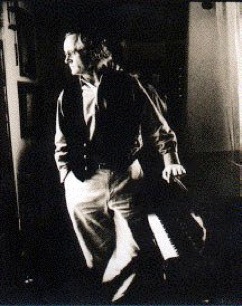
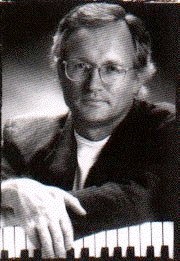
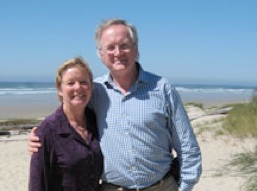
Michael Hoppé’s is one of the most-respected names in contemporary music. Having spent fifteen years as an executive for a large international record label, Michael has had a tremendous amount of experience within the industry as a business-person as well as an artist. He recently released his thirteenth album, “Solace,” which fulfilled a dream of recording with a full symphony orchestra, courtesy of a fan! We did a phone interview in mid-July, and here is Michael Hoppé’s story.
KP: Where did you grow up?
MH: I was born in Cairo, Egypt, and was there for about my first year. My mother and I travelled on a troop ship sometime during 1945, and I then grew up with my parents in London. I went to boarding school when I was seven, and didn’t really live with my parents after that. I would visit them for holidays, and then I was mostly away. After my schooling, I went to the Military Academy (like West Point), much to everyone’s surprise - including my own!
My father told me that I since I didn’t know what I wanted to do, I should go into the Army. I had a lot of free time, as one does in the Army if you’re not fighting, and it was then that I bought literally hundreds and hundreds of Deutsche Gramophone classical LPs from the local Army store. This was in my early 20’s when one has all the marbles going and you retain everything. I listened to those albums constantly. I left the Army after a short service commission, and wanted to go into the music business. My Squadron Major’s father owned a record store, and introduced me to an executive at Deutsche Gramophone. I had an interview, and I suppose I was dazzling because I knew the music so well, and could recognize who was playing almost immediately. I was extremely well-prepared for this interview, and joined Deutsche Gramophone in July 1969. That’s where I was for fifteen years. However, I never went into the classical side. As major corporations often do, they hire you for one thing and then put you somewhere else. I didn’t know a thing about pop music - I never listened to it - but 90% of their business was in pop music, and that’s where I stayed! Polydor was the pop division of Deutsche Gramophone, and Polygram was the parent company. In the end, I became head of A&R [Artist and Repertoire]. I always listened to pop music with a dispassion, really. I would acknowledge it, but the people who became very close friends, who I admire immensely still, are people like Vangelis who knew the pop side but had this wonderful, self-taught, intuitive classical feeling. Others include Jean-Michel Jarre, Kitaro, and ABBA.
KP: You were into classical music as a child, but didn’t play it?
MH: I fiddled at the piano. I literally day-dreamed, I suppose, at the piano. My technique is still pretty awful, but I just meld my own pieces to what I can play. I started to find that I had my own voice. Originally, my piano meanderings were a soundtrack to my thoughts. Having a melancholic nature as a young boy, I would create semi-sad tunes. Really, I did everything back to front. If I wanted to learn to play a piece of music, it was always terribly difficult. I would bash my way through it, and then realize that I didn’t have the technique that I needed to overcome whatever hurdle was on the printed page. So, I would make up my own version. I was self-taught all the way.
KP: You never had piano lessons?
MH: Not really. I had piano teachers, but I was never a good student because I always wanted them to play. I liked listening to them, and that’s how I would learn. I would watch their hands and listen, but I never had a proper formal teaching situation.
KP: Are you self-taught in composition, too?
MH: Yes. I know instinctively where a melody should go and how the structure should be. I just know it. I guess it could be from many years of listening to music.
KP: You’ve done most of your studying by ear. Are any of your family members musicians?
MH: No, not at all. My father liked to listen to music, but I walked along this plank on my own. If you really, really love what you do, and are interested enough, you can overcome any form of parental disapproval - anyone’s disapproval, actually - and still find your way. The support for what I was doing was really never there in the musical sense.
KP: You didn’t have a very close family life if you just visited from time to time.
MH: My father passed away about a month ago at the age of 91. When ones parents have moved on, you start thinking, “Now why was this or why was that?” My father left some writings behind, and we discovered that he had a very difficult time with his own father, the celebrated photographer, E.O. Hoppé. He was a major player in photography from about 1910-1930, and some of his pictures are on my CDs. I think Grandfather found it very difficult to have his son and daughter around. It was a task, and for him, children were not to be seen or heard. Father grew up with a lot of difficulties in dealing with the eccentricities and perhaps the arrogance of an artist, so when I started to fiddle towards music, my father said, “No. We’ve got to give you structure. Go into the Army. Life is business. You’re just dreaming at the piano.” I will always salute and thank my father for imparting the wisdom to learn the structure of the business within my art form. That’s why I went into the music business rather than becoming an appallingly bad concert pianist.
KP: What were your parents’ occupations?
MH: My mother is still an artist, and she does jewelry and painting and all sorts of things that are outstanding, I think. My father became the head of Wrigley’s Chewing Gum. Part of the conflict between my father and his own father was that my grandfather couldn’t believe that his son would go into something so low as chewing gum. And yet it was and is a very, very successful company. So you can see the arrogance and silly thinking that my grandfather had about his son going into such a commodity, but Father did extremely well and was very good at it. That was his struggle, so although I never had strong encouragement from my parents about what I’m doing, neither did he from his own father. The wheel turns....
KP: How old were you when you started playing the piano?
MH: I suppose around seven or eight, but always just “fiddling.” I remember that one of the very first pieces I heard, (on a scratchy 78, probably), was “Moonlight Sonata.” I always thought how beautiful the piano is, with its black and white keys. I would almost caress them even though I was totally unable to play them, but it was “Moonlight Sonata” that got me started.
KP: When did you know or decide you were going to become a professional musician?
MH: After I left Polygram to score a film, I recorded two albums. One was called “Quiet Storms,” with two members of the Los Angeles Philharmonic playing my music superbly. That was my first foray into putting the toe into the water and seeing what it was like to hear other people do my music. Then I made an album called “Homeland,” where I, for the first time, played some of the pieces - a further progression. My breakthrough, however, was “The Yearning,” which has been one of my best-selling albums. At the time (1991), I had a consultancy (InterConnection). I was still dithering whether to run back to the corporation I felt comfortable in and was good at, or whether I had the guts to really pursue being a composer even though I couldn’t read music very well. There were lots of reasons why I couldn’t and shouldn’t, but when I had this consultancy, one of my clients was the celebrated flutist, Tim Wheater. He had several albums I was shopping for him, and we became very good friends. One day he said, “I know you’ve done some tunes. Why don’t we record something?” I said, “No, I don’t really think there is any point in it. The pieces are all slow and somewhat sad, and since I was head of A&R, I should know what the marketplace wants.” Tim said, “I don’t care; I think we should do it.” A friend who became our producer, Frosty Horton, brought over a DAT player to record us, and I tell you, Kathy, I wept. We just recorded three pieces, and I had never heard my music played with such emotion. I was incredibly moved. At that point, I put on my business hat and started to shop those three titles, and I received four offers! I said, “Timothy, we seem to be onto something here! Let’s finish this record.” And that’s what became “The Yearning.” It was recorded on the cheapest equipment you can possibly imagine. Everything was wrong, except everything was right. It has magic!
KP: It blew me away the first time I heard it! Then I started scrambling around saying “I’ve got to find more of this stuff!”
MH: Tim was at the peak of his form, and all of those pieces are without edits. There were many takes, but everything was done, ultimately, in one pass. And I had hardly ever recorded! There was one point when I kept telling myself, “Michael, you’d better not mess this up because Tim is reaching heaven itself.” And luckily, I didn’t, but it was very nerve-wracking for me because I knew I was in the presence of something incredible. Next, we bought some better equipment and made “The Dreamer.”
KP: Did you compose the music to go with your grandfather’s photographs, or did you match your music to the photographs later?
MH: The latter. That was sort of my marketing training, really. I thought, “Okay, I have these lovely tunes and lovely performances, now what do I do with them?” Around the same time, an extraordinary situation occurred. A neighbor called me about a photograph of Isadora Duncan that my grandfather had taken. That eventually led to my discovering, in London, over 5000 images my grandfather had done. They were all brought back here and put into a vault in Pasadena. I then started to marry the album that I had made with Tim to the individual photographs. I gazed at the eyes, the moods, and the often unsmiling nature of these beautiful women, and I married the music with images by my grandfather. Then I wrote a bio about each woman who was represented. That’s how it was done. With “The Poet,” which is “Romances for Cello,” I made these beautiful recordings with Martin Tillman, a fantastic cellist, and wondered what to do with them. I knew my grandfather had photographed many literary people, so I started looking for the poets who sat for him. I found a poem written by each person he had photographed and matched them with the music. With all of my albums, I record the music first, and then I see what I’ve got. Then I assemble it underneath the umbrella of a title that seems to encapsule everything.
KP: I’m sure once you have a body of work, an overall theme starts to emerge that can tie it together.
MH: That’s right. One of the things I love about CDs is that each is a containment of one’s intention. It’s a completion, like a book.
KP: Did you know your grandfather?
MH: Very well. He died in 1972 at the age of 94, and I would say I was rather close to him. He was about 5’5”, a short and often difficult man, but I got on with him very well.
KP: What do you consider to be your biggest musical influences?
MH: Definitely Rachmaninoff - I just adore his voluptuous, melodic characteristic, and of course, his phenomenal piano playing and how he made the piano sound. Chopin - I love that sort of singing line and the melancholy - the sort of wistful looking out of the window at the pouring rain... For conciseness and classical correctness, I like Mendelssohn. I love the “Adagio”s of many of Beethoven’s pieces, but it is basically the Schumann, the Chopin, the 19th century Romantics I adore. And really, I take my hat off to anyone who can write a good tune!
KP: What inspired you to start composing your own music?
MH: I couldn’t help it!
KP: It was something you had to do?
MH: Yes. The only way I can say it is that after years of tinkling about, it was like a sonic aspirin for me - I felt better afterwards. Even though I knew it wasn’t cohesive or a composition in any sense whatsoever, I gradually managed to lasso those wild horses of thought and put them in some form of corral that became a composition. One of my very first pieces was called “The Parting.”
KP: The one that Vangelis re-did on “Solace”?
MH: Yes. Vangelis did the first part of it. I just really started composing about 1975.
KP: When did you come to the US?
MH: We arrived in New York in 1981.
KP: Did you leave Polygram so you could do your own music?
MH: Yes. I was warned by the chairman, who I got on very well with initially. He said, “I can see by your enthusiasm that you like sitting at the piano and showing me what you do, but I must warn you. You either do that fulltime or you stay with us, but you can’t do both. I do not wish to hear what you’re doing on the piano. Have I made myself clear?” I was really dressed down. You see, I was their blue-eyed boy who was being groomed for big things. They found it very disturbing to have this promising young executive who was responsible for world-wide operations in pop music getting all euphoric about 19th century Romantic music. The chairman didn’t like it at all, and it was one of those turning points that we all have, I guess. I knew I would have to face it one day. Three years later, by chance (if there is such a thing), I was given a Gene Hackman film to score. I had to leave the company, but part of the arrangement was that they would bring out the soundtrack (on vinyl!). Monica and I travelled by car from New York to LA with a trunk full of soundtracks. That’s how I left.
KP: The film was “Misunderstood”?
MH: Yes, it was a relentlessly sad film, and it only stayed around for about ten days.
KP: So it wasn’t one of Hackman’s hits.
MH: No. It was just so sad that anybody who watched it wanted to throw themselves out of the window! It was well-acted, and had some big names. It had been a huge hit in Italian, but when they remade it, the magic was not recaptured.
KP: Have you just scored the one film?
MH: I’ve done four, but “Misunderstood” was the feature film. My music has been used on “The Sopranos” and is often played on Oprah Winfrey.
KP: This is all music that was previously recorded, not music that you composed specifically for these things?
MH: No, but I really love it when somebody sends me a script, and then I write a theme on spec. For example, on “Solace,” there’s a piece called “Jude’s Theme.” That was a theme that was written for a film called “Jude the Obscure” about eight years ago. If you tell me a story, I love writing music for it. That’s why I enjoyed doing “The Lover.” Now I’m recording a project with Michael York, the celebrated actor. He is reading love poems by various well-known poets and I put music beneath them like a film score. Recently, I completed an album I was commissioned to do by a relative of Longfellow. It’s really beautifully put together.
The success of any project has everything to do with timing. When I was running A&R, the more passionate I was that something was definitely going to work, definitely going to happen, it invariably never did. Then those projects which were considered nice but not remarkable would suddenly take on a life of their own. For whatever reason, timing is everything. I’ve seen that, for example, with the little tune called “Music Box Dancer.” When I was in Canada back in 75, Frank Mills and I got together, and, at my behest, he recorded various covers of current hits. Because of his investment in a project I was unable to use, Frank almost went into bankruptcy and had to drive a taxi. Before he left, I asked, “Do you have anything I can put out for you?” - I felt so bad for him. He said, “I have this record that I did four years ago for a record company that has since gone bust.” I asked him what was on it, and what his most-played items on the radio were. He said “The Poet and I” was the most-played, and then “Music Box Dancer.” I said I’d put “Music Box Dancer” on the B side and “The Poet and I” on the A side, and if anything happened, I’d give him some money. He then drove off to his taxi life, and I went away on holiday. When I returned, the promotional person at Polygram said, “We’ve got a hit with Frank Mills! It’s called ‘Music Box Dancer’! Somebody played the B side in Ottawa, and everyone’s gone crazy!!” It went to #1 across America, and #1 around the world! Frank Mills moved his family from Canada to The Bahamas, and as a gift, he gave me this grand piano which I record on!
KP: And now the song is on ice cream trucks all over the country!
MH: The whole thing worked because of timing. It was wrong for him earlier, and then it was right. The song went right to #1 in the middle of disco! It had nothing to do with anything that was going on at the time. I’ve often thought about it, and the only reason it was so popular was that it was so refreshingly different from anything else.
KP: What has been your most exciting musical moment or experience so far?
MH: There have been two things. One was to have gone through a riveting performance without messing up. I think one of the first times I felt that was with Tim, and it was tremendously exciting. The other occasion was something which I had never done before. I had never, apart from at school, performed, and to go to Korea last November and play for more than 2000 people at the Seoul Art Center was a real rush. That was a very personal breakthrough.
KP: Much of your music seems to be very melancholy, and yet you seem to be a very contented and together kind of person. Is there a dichotomy here?
MH: I can’t really say where it comes from, but I have to play, record, and compose music which moves me, and happiness, in musical terms, doesn’t cut it at all. I don’t like jolly music. Most of my music really is internal - it’s heart music. It’s reflective and evocative. If it has a sense of melancholy at times, that’s what I’m really moved by. For example, I’ve always really only been moved by the middle movements of concertos. I think this is where the composer is naked - he can’t cover himself with all sorts of bangs and whistles and flourishes. This is where we’re going to hear straight, undiluted melody, and we’re going to hear the real heart without disguising it with often flashy virtuosity. So that’s why I just naturally gravitate to the slow movement, which invariably has a sense of melancholy. The very first thing I can remember adoring in music was the Adagio movement of the Emperor Concerto (Beethoven).
KP: On a little more personal level, do you have any hobbies?
MH: I love fly fishing for trout, and I was thinking about making an album for flyfishers. “This Majestic Land” was written to start that album, with the glorious Rocky Mountains and the rambling streams... Other things I love - I paint sometimes, although I haven’t done it for quite a few years. I just love art - all forms, really.
KP: You did the cover photo for “Solace,” right?
MH: Yes, I did. It was one of those lucky shots.
KP: Other than fly fishing, what do you like to do in your free time?
MH: I like going to museums. Monica and I travel a lot. We’ve just been to Mexico, and we’re going to the southwest next week. Anything to do, really, with art. I have all sorts of interests that I’m crazy about. Anything that’s beautiful - it doesn’t really matter if it’s a painting or a Lamborghini!
KP: If you could have any three wishes, what would they be?
MH: That we all find peace in ourselves, that my music would help in some way to find that peace. I don’t know about a third one. This isn’t a wish, but I’m just deeply thankful for the life that I have. I’m deeply thankful to be able to follow and pursue my bliss, and to be able to do that without any formal expertise or training, to be able to mold my own career around what I love doing. I can’t imagine there could be any better way to live.
KP: Do you have any words of advice for young people who are studying music?
MH: Yes - not be distraught or destroyed by a lack of technique; to be sure that technique is of service to your intentions; and not to just hear music, but to listen to it - to close you eyes and just listen, and to let the heart be the wonderful receptor that it is. If music can reach your heart, no matter whose music it is, that’s It. So to any student, if you’re playing or performing music, perform from your heart regardless of any technical inefficiencies. Students shouldn’t be put off by the reasons why they can’t do it. I’ve had many reasons why I can’t do this, and I haven’t obeyed any of them!
For more information about Michael Hoppé and his music, visit
his website or check out his
Artist Page here on MainlyPiano.com
Kathy Parsons
September 2003