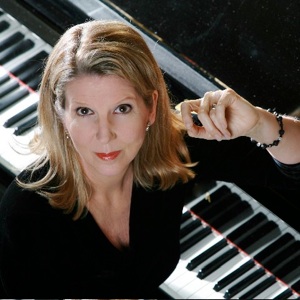
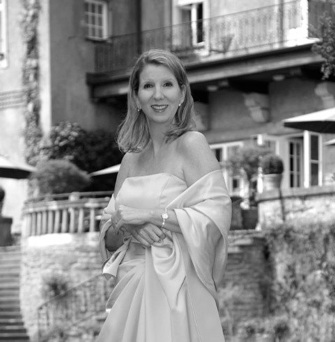
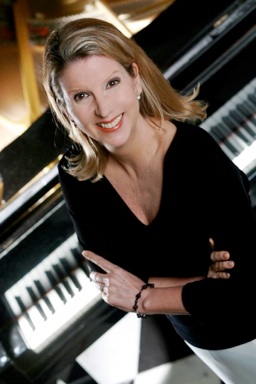
Robin Spielberg introduced me to Robin Meloy Goldsby and her music about ten years ago (the two Robins are the best of friends), but this is the first time we’ve done an interview. Robin G. and I reconnected a couple of years ago when she asked me to write a “blurb” for her then-new book, “Piano Girl: A Memoir.” I absolutely loved the book, so I was thrilled when she asked me to review her second book, “Rhythm.” Robin has been a professional pianist since her teens and now lives in Germany, trading New York City hotel lobbies for ancient castles to weave her musical magic. Robin is a wonderful writer as well as an incredible pianist, so it’s fantastic for us that she is making both work for her. I think you’ll love her story.
KP: How old were you when you started playing the piano?
RMG: Nine. My teacher, William Chrystal, refused to take students before the age of nine, unless they were genius kids. I never fell into that category!
KP: How long did you take piano lessons?
RMG: I studied with Mr. Chrystal for twelve years, but he'll always be my teacher. Three decades after I stopped studying with him, some of the things he taught me are just beginning to sink in.
KP: Do you play other instruments?
RMG: Yes, I play the flute, which is much easier than the piano. I often think that anything is easier than learning to play the piano.
KP: Where did you grow up?
RMG: I grew up in Pittsburgh, Pennsylvania, where my father worked as the drummer/percussionist on the Mister Rogers Neighborhood television program.
KP: How many brothers and sisters do you have? Are any of them musicians?
RMG: I have one brother and one sister. They both love music, but neither of them chose to make a career of it. My sister learned to play one song on the piano—"Eleanor Rigby." She can still bang it out on a moment's notice, but you wouldn't want to be the room.
KP: When did you start playing professionally?
RMG: I was an accidental pianist. I got my first job on Nantucket Island in 1976, when I was eighteen years old. I wanted to be a waitress, but I ended up with a piano gig instead, playing in a bar for a bunch of salty old sailors. I had no clue what I was doing. When I started out I knew ten songs and nine of them were Bach. Not exactly piano bar material. But they were polite and just drunk enough to enjoy what I was playing. Most likely they were waiting for my tube top to fall down. In addition, we had “Gay Night” every Thursday. Playing for that wonderful crowd helped shape my repertoire, and it certainly had an impact on my wardrobe choices!
KP: How old were you when you moved to New York?
RMG: Twenty-one. I was fresh out of college and ready to take Broadway by storm. I had a theater arts degree. I ended up on Broadway, but behind a piano in a Broadway hotel, not onstage like I had planned.
KP: How long did you play in hotels and restaurants?
RMG: I'm still playing in a hotel. Okay, it's a European castle, but still, it's a hotel. I started at age eighteen and I'm fifty-one now. It's a long time, but it strikes me as a dignified way to make a living and something I'll always enjoy. There aren't many performance jobs that allow you to grow old and keep working, but this is one of them.
KP: Did you keep a journal during those years that you could refer to as you were writing “Piano Girl”?
RMG: Yes! I have volumes of journals. I wish I could tell you I was very organized about documenting my experiences, but many of my journal entries were first written on cocktail napkins, during breaks.
KP: What made you decide to write your autobiography?
RMG: Funny thing about “Piano Girl” — although it's my memoir, I sensed right from the start that I was writing it for every musician who plays background music. I often find myself having to defend my profession, and I knew if I presented my story in the right way I might be able to change the perception of the service we provide. My hunch proved to be accurate. I've received many wonderful letters from musicians thanking me for speaking up for all of us.
I was also aware that anyone who plays the piano in a bar or hotel lounge has a million stories to tell, but that no one had actually written a book on this topic. I wasn't sure that anyone other than another musician would want to read it, but I was wrong about that. “Civilians” relate to the book as well as musicians—probably because the stories help to demystify the business of making music.
Playing the piano in a bar is the ultimate musical fly-on-the-wall job. We see and hear everything: mundane, miraculous, laugh-your-ass-off silly, cry-your-eyes-out tragic. What a privilege to be able to observe the best and worst of humanity while doing something we love—playing the piano.
KP: Are you going to follow up “Piano Girl” with “Piano Woman”?
RMG: No! The title “Piano Girl” sounds like a cute marketing ploy, but it actually comes from a mentally-ill woman who used to hurl philosophical insults at me as I walked to work. The first time she yelled at me she said: "Hey you, PIANO GIRL! Your spindly legs are not strong enough to support the weight and burden of your soul." She never called me by my name, she always called me “Piano Girl.” That's how the book got its title.
I'm working on another book of essays about music, but it won't be called “Piano Woman.” I'm a slow writer, so maybe by the time I'm finished I can call it “Piano Geezer”! Just kidding—I do have a title for my next book, but it's still a secret!
KP: When did you meet Robin Spielberg? Tell us about that.
RMG: A million years ago, Robin was doing the actress/waitress shuffle at the Marriott Marquis in New York City, serving pina coladas to goofy guys attending orthopedic supply conventions. I played the piano at this hotel. At the end of one evening, as I was preparing to leave, I heard the most beautiful music coming from my piano. I peeked around the corner, and there she was, still in her waitress uniform, playing for herself while the housekeeping team cleaned up cocktail debris and polished glass tables. I had known her for a year and had no idea that she could play. I've documented the details of the story in “Piano Girl,” but here's the short version: I introduced her to my agent (Harlan Ellis) and within a week she had a job playing at the Grand Hyatt at Grand Central Station. She stayed there for years and years, perfecting her compositions and arrangements and readying herself for the amazing concert career she eventually carved for herself. Robin Spielberg is the ultimate cocktail pianist success story, if you ask me. She used her time in the trenches to find her artistic voice.
KP: Robin introduced us quite a number of years ago, and I’m really grateful for that. Do you still stay in touch on a regular basis?
RMG: Robin S is my best friend. We live an ocean apart but we write or talk almost every day. She produced two of my three recordings. I cannot think about piano music without thinking about her. She wrote a song for me called "Seeing You Seeing Me" and recorded it for her latest CD, “A New Kind of Love.” It's beautiful! And she put a little musical joke I there for the two of us, kind of a secret code.
We share many of the same musical tastes, but we also share the same philosophy about competition in the arts. Both of us strive to take the high road in our artistic and business dealings, and neither of us has time for the competitive manipulations that some of our colleagues seem to favor. Look at us, for instance. We are two women with the same background (theater and music), we play very similar styles, we both tell stories and compose songs, we even share the same name. It would be easy for us to compete with each other, but we don't. Robin has always supported my work and I do the same for her. And both of us are very quick to praise the work of other artists. There really is enough cosmic space for all of us.
KP: How and when did you meet John Goldsby?
RMG: At the Hyatt! Most romances end up in a hotel. Our romance began in one. I was playing cocktail piano there in the evenings (Robin Spielberg had the afternoon shift), and John (a bassist) was playing with a jazz trio out in the lobby. Anyway, John and I began taking breaks together. I don't know what attracted me more, his talent or his looks. There's just something about a guy with an acoustic bass. Heaven. My mother met him and told me to throw a net over him, which I did. He cooperated.
KP: When did you decide to move to Germany? Why Germany?
RMG: When John was offered the bass position with the Grammy winning WDR Big Band, it seemed like a logical move. Our son was not quite two years old, and we were looking to get out of New York. Germany was a little farther than we had planned—we were thinking Connecticut or New Jersey—but I had always fantasized about living in Europe. We love it here!
KP: Your three CDs are all gorgeous. Not everyone can play music that works well in the background and holds up just as well with full attention. Yours does. Do you ever just cut loose and play boogie woogie or blues or hard rock?
RMG: Thanks for that very fine compliment! It has always been my goal to play music that is subtle enough to blend in, but substantial enough to hear. I make my living staying in the background, but I keep myself stimulated by making harmonic choices that aren't obvious. I improvise, and by playing so many live gigs (I play about 200 jobs a year, a combination of background jobs and formal concerts), I learn what works and what doesn't.
I can and I do play boogie-woogie or rock when it's necessary, but that's not really the kind of music I enjoy. I think musicians really shine when they play what they love. I grew up listening to so many different kinds of music. All of these styles have contributed to the way I play, but after many decades of experimenting with many different styles, I've found my own piano voice—it's a voice with many echoes of other musicians, but that's the way art works.
KP: Is most of your recorded music original?
RMG: I'm a slow writer and a slow composer. Unlike the extremely prolific Ms. Spielberg, I've only recorded three CDs. For the first, “Somewhere in Time,” I played covers of standards and pop songs that I've always loved. “Twilight” is a recording of my compositions. “Songs from the Castle,” my newest CD, includes eleven original pieces and four covers. But you know, I have this theory about players and songs. Even if I haven't written the piece I'm playing, I always try to find an emotional connection that's strong enough for me to own the music for the time it takes to play it. So even though I play a lot of covers, I feel like they're mine in some unique way. As a songwriter, I understand a performer's need to do that.
KP: When you were playing in New York, were you playing mostly cover material? Were you able to play some of your own music as well?
RMG: Right from my very first job, I began playing original material along with covers. My dad gave me some really good advice. He said: Give them a little of what they want to hear, then give them what they ought to hear. He also advised me not to copy other pianists, to play music that I loved. I play my new-agey-floaty-jazz-influenced style in venues that previously employed show-tune musicians or classical musicians. And it works. Not because it's fabulous music that everyone wants to hear, but because it's music that I love to play.
KP: Did you release any albums while you were in the US?
RMG: Yes, “Somewhere in Time” was released about ten minutes before I left for Germany. The session (which was accomplished in a day, with Robin Spielberg's production expertise) was one of those turning-point moments of my career. We were in Nola Recording Studios in Manhattan, where I played Erroll Garner's Steinway. Robin gave me a tiny sky-blue crystal globe for good luck. It still sits on my piano here in Germany and I carry it with me to important events and recordings.
KP: Now you do a lot of your playing in a castle! Is there are restaurant there or are you playing music for events like weddings?
RMG: I play at Schloss Lerbach every weekend. I also play for private engagements like weddings, anniversaries, and corporate parties. I've found a nice little high-society niche for myself with the private party business at this castle—the jobs pay extremely well and subsidize my recording and writing career. Plus, it's fun! The grand piano sits in the middle of the castle's main hall. It's spacious and the acoustics are wonderful. All of the party salons, the bar, and the Michelin three-star restaurant are adjacent to the main hall—so guests can hear me without being right on top of me. I can play as loudly or softly as I wish. And the champagne is to die for. Sure beats the rosé swill they served at the Redwood Motor Inn in Pittsburgh where I had one of my early jobs!
KP: Do you play in several castles or just one?
RMG: In Germany, castles are like Starbucks—there's one on every corner. Not really, but there are some amazing castles in this area. I do accept jobs or concert events from other places as long as I know they have a good instrument (or they're willing to rent one for me).
KP: Do you do concerts now or does that still make you really nervous? I don’t have any problem playing in the background or for students, but I can’t handle the pressure of performing, so I could really relate to the parts of your book where you talked about that!
RMG: Ha! You get it, don't you? When I was suffering from this predicament it was very difficult for me explain my problem to “civilians.”
Other than Robin Spielberg, no one else knows this story. Here is how I got over the paralyzing anxiety attacks that prevented me from playing concerts: A good friend of mine here in Germany, Conny Traupe, used to accompany me on walks through the woods that surround my home. We walked three times a week, ninety minutes each time. As you can imagine, we talked about a lot of things on those walks. Conny was furious with me for refusing to play formal concerts. She thought it was ridiculous that I could play four hours of background music, that I could write and record music without breaking a sweat, but that a concert sent me into a crippling tailspin. She was actually angry with me for refusing to consider a formal engagement (at that point two of my CDs had been released and I had a fan base).
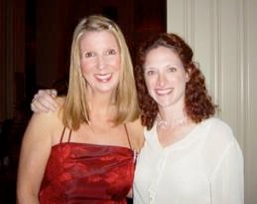
Robin with Robin Spielberg
So. In the midst of our walks and conversations, life happened. And so did death. Conny was diagnosed with breast cancer. She fought an amazing fight, stunning all of us with her courage and will to live. Before she died, she left instructions with her husband that I was to play a solo piano piece at her memorial service. There was no backing out. My grief for my lost friend was far more potent than my anxiety. I played a piece I wrote for her, called "Mountaintop." (Songs from the Castle) The anxiety fizzled and faded. It was the saddest event of my life, but also one of those remarkable turning points for me. I figured if could get through something this heartbreaking—with 300 people depending on me for musical comfort—then I could get through anything. It was Conny's final gift to me. I say a silent thank you to her every time I play that piece
She died shortly before “Piano Girl” was published, but I managed to get her name into the acknowledgements, as a member of the “Choir Invisible.”
KP: Both you and your husband are professional musicians. Are either of your kids musically inclined? How old are they now?
RMG: Our children are sixteen and twelve. Both of them are extremely musical. Curtis is an excellent writer and Julia is quite the artist. Both kids play the piano. Julia sings, Curtis plays percussion and drums. We have a very loud (but happy) household.
KP: How would you react if either of the kids announced that they wanted to be professional musicians?
RMG: My wish for my children is for them to choose their careers based on their passions.
KP: Jane Bowman, the main character in your second book, “Rhythm,” is quite different from you. Was she a completely fictional character, a composite of people you have known, or have you known someone like her?
RMG: Most novelists develop their characters by using traits they have observed in people they know. Jane is someone I'd like to be. I loved getting under her skin for the three years it took to write the novel. Because I'm a solo pianist and I was writing about a female funk drummer who plays with R&B bands, I had to do some research into what it's like to be a female player in the biggest boys' club in the world. Karolina Strassmayer, a jazz alto saxophonist, helped me explore this world. Jane is not Karolina, but Karolina gave me the courage to take Jane where she needed to go and maintain an authenticity, something that was very important to me.
KP: One of the things I really loved about “Rhythm” was the passion the characters had for music and their dedication to it. As a piano teacher, I found myself getting very frustrated because so few of the kids were willing to put in enough time to really improve. “Good enough” seems to be a chronic disease that is seeping into so many parts of American life – except maybe sports. Have you seen much of that in Germany?
RMG: The passion the characters in “Rhythm” have for their music—that's the kind of thing I see in all the musicians I admire, regardless of genre. Without that passion, you can never be a great musician. You might be functional, but not great.
For many young students, "good enough" is a sign that they've reached the limits of their passion. I hate to keep using the "p" word, but if they're passionate about music, they'll want to improve.
Sports, in particular soccer, are a major part of European life, but the arts don't suffer just because sports are popular. Culture plays an important role in the life of every child. When I attend concerts here, the audience is usually a glorious mix of young and old, rich and poor. Schools have bands and orchestras and choirs. Kids attend concerts.
Government programs help. Many artists in the USA argue that government should never be involved in arts programs, but I disagree. By supporting its artists, a government rewards its citizens. It nurtures future audiences and future artists.
KP: I’ve heard a lot of musicians say that American audiences have such short attention spans. Is it different playing for European audiences?
RMG: I'm not sure that's true. People who attend concerts in the USA pay attention. The trick is getting them into the concert hall. Europeans seem to be better at attracting audiences—concerts are plentiful and affordable. There are many events that are free of charge. Recently, my husband's band held an "open sound check/rehearsal" at the Philharmonie concert hall in Cologne. 2700 people showed up at 1:00 in the afternoon to listen. Many audience members were business people on lunch, but most of the attendees were school groups. That night, the concert was sold out. It was also broadcast live.
KP: Is classical music still alive and well there or is it dying out slowly?
RMG: Alive! Well! Kicking!
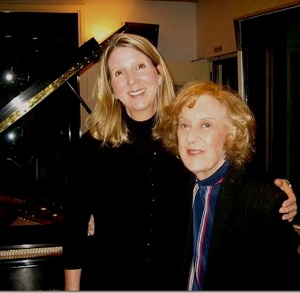
Robin with Marian McPartland
KP: Traditionally, Europeans have put a much higher value on the arts in general. Is that still true?
RMG: Yes, but it's not because the Europeans have better taste or higher standards. It's because people learn—early on—the importance of culture. I can't stress enough the importance of arts education in the schools. Children need to go to museums, concerts, and art exhibits. They need to watch ballet, and listen to opera.
KP: Are you doing much composing these days?
RMG: I have spells of writing music and spells of writing words. I don't really separate the two. After all, music can be poetic and well-written prose is very musical. To me, it all comes from the same place in my brain, and when I'm lucky, my heart. To answer your question, here's what I have on my desk: Two lyric assignments for a European record producer, one lyric assignment for a singer I love, an article assignment for “Expatriate Living” magazine, two concert programs to plan—one in Lithuania!—and an outline and proposal for my next book, which will be a collection of essays about living and working as a musician in Europe. I started work on it last fall. As I mentioned before, I'm a slow writer, so it will be another year before it's ready for publication.
KP: What’s up next for you?
RMG: My kids are teenagers. I plan to be home as much as possible in the next few years. I feel very blessed to have writing work that I can do at home, a performance venue just twenty minutes from my front door, and time to spend with my family. As far as my career is concerned, the next big thing will be book number three.
KP: What was it like doing the radio interview with Marian McPartland? Have you known her very long?
RMG: Appearing on Marian's program was a magical experience for me. I recorded the show back on May 18, 2006 at Manhattan Beach Studios in New York City. It has been broadcast twice since then, most recently in January 2009. She also had me on two of her Christmas specials.
http://www.npr.org/templates/story/story.php?storyId=100033265
As my pianist friend Daryl Sherman says, the 90+ year old Marian McPartland is "one of the wonders of the world."
Those of you who are familiar with my playing know that I am not a jazz musician, so before recording Marian's show, I felt a little NERVOUS. I was a mess. The “Piano Girl” publicist, the intrepid Nina Lesowitz, attempted to calm my rattled nerves by taking me shopping for junk jewelry on 34th Street, a distraction that can normally get my mind off of anything. It didn't work. My stomach churned and I kept thinking, "What am I doing? I'm not a jazz musician and here I am going on the biggest jazz radio show in the world."
Okay, my music is jazz-influenced, but somehow I didn't think that would be enough.
It turned out to be enough for Marian. She summed it up best, I think, when she said, "Oh, it's all just music, isn't it?" Her graciousness put me at ease immediately, and I was able to relax enough to forget that we were recording an international radio show.
I've been around enough jazz and classical purists (some might call them snobs) in my life to really appreciate an accomplished musician who has big ears for everything. To find this quality in a woman of Marian's age is also remarkable. No wonder she seems so young.
At the end of the three hour recording session, producer Shari Hutchinson asked me to record a couple of Christmas songs for use on the NPR Jazz Christmas CD with Marian McPartland and Friends. I did. The CD is now available and includes one of my compositions for the holiday season, called "Magic in the Night." I'm stunned by the jazz celebrity status of the other artists on the recording. Marian herself, Susannah McCorkle, Blossom Dearie, Michel Camilo, Billy Childs, Bill Charlap. Opera diva Renée Fleming sings one of the tracks. Then there's me—the new-agey-make-it-sound-pretty-gal. On a jazz CD. But why not? It's all just music, isn't it?
KP: Does your dad still play percussion, or has he retired? He has had an interesting career, too. Want to talk about it a little bit?
RMG: Musicians never retire, not really. Look at Marian! The Mister Rogers Neighborhood program stopped taping a few years before dear Fred Rogers passed away. But my dad keeps playing—concerts, jazz gigs, whatever comes up. He and my mom live on a lake in Western Pennsylvania. It's so great to have two parents who really understand my passion for music. My mom isn't a musician herself (okay, she can play Deep Purple in a march tempo on the piano) but she's a music lover. If you ask me, that's just as important.
Be sure to check out Robin Meloy Goldsby’s website at
goldsby.de. Reviews of both of her books and all three CDs are on her
Artist Page on this site.
Kathy Parsons
March 2009