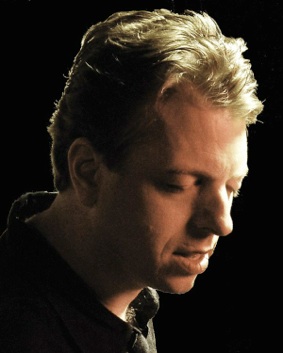
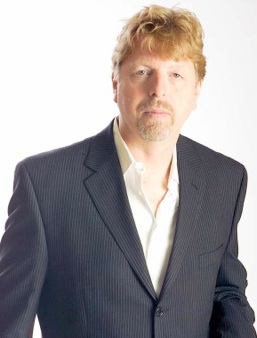
Pianist/composer Ben Dowling and visual artist Mark Wagner recently released an extraordinary CD/DVD called “The Path of Peace.” Released under the name of Visionsound, the concept envisions a partnering with Dowling’s music with dance, poetry, painting, photography, film art, etc. Combining music and visuals is not a new concept, but Visionsound’s approach is unique, as is the DualDisc format. One side of the disc is the piano music only, and the other side is a multimedia DVD with Dolby surround-sound, fixed and random presentations of the art and music, and other features. I watched the DVD several times in the course of reviewing it, and was mesmerized each time, realizing I was experiencing something very special. Wagner created some of the the artwork while listening to Dowling’s music, so they are very intertwined.There is constant very slow movement in and around each piece of artwork as the music plays.
Ben Dowling was born in Fayetteville, Arkansas on February 14,1956. His family moved often as he was growing up, but most of his formative years were spent between New York and Vermont. Ben’s father is a retired evolutionary biologist who worked with the classification of snakes. Ben’s mother is also retired, but was a key administrator at both Bennington College and Boston University. Ben has one brother and two sisters. None are professional musicians, but his sisters used to sing together.
KP: How old were you when you started playing the piano?
Dowling: I started when I was about seven - mostly because my older sister was playing. I rarely practiced and progressed accordingly. After a couple of years, my teacher suggested that I take some time off. That began a period when I tried things like playing along with popular songs (badly), but it wasn't until I heard some Bach organ music at ten or eleven that I felt compelled to continue my study of music. At this point, music became the central focus of my life, and Bennington, Vermont turned out to be a perfect place for such an interest. Bennington is an amazing music community, and experimentation was the order of the day. While I was being trained as a classical organist with piano as a sideline, improvisation and experimental composition were discussed, practiced, and performed, and people were there who could assist me as that part of my musicality emerged.
KP: How old were you when you started improvising?
Dowling: I discovered the blues when I was around twelve, and it was an epiphany. Here was something that couldn't be explained rationally, but was compelling musically. I went from using the blues scale for note selection to what I call "sub-routine" playing, where you memorize cool licks and try to apply them to everything [laughing]. Real improvisation came later when I had more practical knowledge and worried less about doing it right. I studied improvisation with Ran Blake of New England Conservatory, learning the basics of ear training and a love of harmony - "spice," as Ran called it.
KP: When did you write your first song?
Dowling: As I remember, my first “official” song was written around 1975 for a fusion group called "Point of Departure." I was about nineteen and a student at Boston University (which I later flunked out of). It was an amazing time to be alive and musical. I formed the group with three other jazz players (bass, drums, vibraphone) who were also inspired by Miles Davis' progeny - Herbie Hancock, Weather Report, Mahavishnu and the rest. Also inspired by Chick Corea's “Light as a Feather” album, I named my first piece "Flora" from that. It had kind of a Latin sound and all minor chords, but was simple enough for us to play and improvise over.
KP: When did you start playing professionally?
Dowling: I think my first gig was with a country band in Vermont when I was about sixteen. I really enjoyed myself, although I was a longhair at a time when that was not widely accepted in the sticks of Vermont. I guess they considered me enough of an artist to accept the hair thing, but I was teased mercilessly. Since that time, I've played in nearly every genre and style. I think that as long as you play with excellence as your highest aim, any style of music can be great. I've really come to believe and practice that.
KP: Who or what are your biggest musical influences?
Dowling: Pianistically, I would say that Chopin is a very strong influence because of his attention to touch and dynamic as well as melodic and harmonic content. It’s amazing how music that was written for the piano in the 1820's can still move people. That's a living history that transcends everything else.
Miles Davis inspires as an artist who was constantly creative and growing. He never repeated anything, and that required him to design and scale his music to be able to evolve. That's important, because some music is so closed-ended that it is very hard to break out of the internal design. Playing the "wrong" lick in a country/western song is just plain wrong, but if you design the architecture differently, it's possible to break rules and still be true to your own progressive development.
Of the improvisers, there are so many. Keith Jarrett is extraordinary in the traditional sense, owning the touch and dynamic of Chopin with the harmony of the jazz standard. Herbie Hancock is still one of the most important voices out there. I love his recent Joni Mitchell record for its elegance, honesty, and beautiful splashes of harmonic color. There is a host of upcoming Cuban players that absolutely takes things to a new level.
KP: About how many pieces have you composed?
Dowling: I have boatloads of compositions, scraps of compositions, harmonies that I love, melodic fragments, etc. I committed myself to writing ideas down, initially to become a better reader, but I still do it. You can see structure on paper differently than you do in your hands. Nowadays, we have such instant ability to record that I try to complete things that are worth completing, or at least document them well if I can't. With my ProTools HD rig, Korg Oasys, and acoustic piano, I have everything I need to make great recordings. I also work as a producer to help people create recordings that represent their artistic visions. I'm picky about what I release, but I record almost everything. It's amazing what you learn just listening to yourself play.
As a side note that might be helpful, in my mid to late 20's, I had the starts to some absolutely amazing pieces of music, and I dragged them around for years. I wasn't able to complete them the way I wanted to, but I wasn't able to let them go either. I was totally stuck, and they became burdens instead of gifts. I finally decided to put these ideas into a filing cabinet and move on. Freedom! I don't think I would have written anything more if I had not been willing to set these wonderful ideas aside and allow them to gestate. Someday I will revisit them and see if they really are as great as I once thought they were.
KP: Is “The Path of Peace” your first solo piano CD?
Dowling: "The Path of Peace" is actually my first official recorded project. I did an EP of some of the material called "Ahimsa" some years ago, but it was an incomplete collection and was released primarily as a learning experience. I do have other recordings with my compositions on them, but not on a record with my name on the front cover.
KP: What was the idea behind “The Path of Peace”?
Dowling: I've been involved with a spiritual practice over the past twenty years that values focussing on the moment and honoring the possibilities of that moment. It was wonderful to find the Agape community (Rev. Michael Bernard Beckwith's church - of "The Secret" fame), because I discovered that my musical journey has been a spiritual practice all along: the commitment to excellence, the commitment to being in the moment, the intention of anchoring something positive, and a service to the planet. I’ve always wanted to leave something that made a positive impact, but I had never looked at this as a "spiritual" thing. I guess I was confusing "spiritual" with "religious." Anyway, as my own practice of meditation proceeded, I found most "meditation music" to be rather vapid and uninteresting. Later, I discovered that some of this was by design, but that rubbed me the wrong way. Since my music was a form of meditation, I decided to create a project that exemplified this in a way that was committed to the service aspect of the work.
During the developmental phase of this project, I was traveling with Al McKay of Earth, Wind and Fire, playing a funk gig and seeing the world in some of its most difficult straits. In Indonesia, I saw people living in dumps, drinking fouled water, and worse. Elsewhere in Asia, people live in warehoused facilities, stacked like lumber. I kept thinking, what can a musician do about this? How can my visiting this place create a net-positive result? How do I give instead of take?
The genesis of the idea came from Japan, where I watched people leave their jobs late at night and return the next morning. There, as in most of developed world today, people are surrounded by sensory input all day long. The density of this input is growing faster and faster, and it's everywhere. People just don't "do" silence anymore. It's difficult to find and other options are easier. “The Path of Peace” is a way to fill the sensory pathways with total immersion in a state of peace and beauty. I felt this would be an environment that people could use in the background of their lives and gain some sense of balance. The project also came about from the development of technology, and I go into that on my website [
visionsound.com - "About the Art"].
KP: Let’s talk about the concept of the album.
Dowling: The technology of the project was based upon a new disc format called "DualDisc" which is essentially a CD on one side and a DVD on the other. On one level, the project is twelve "music videos," for lack of a better description. Each is created around one piece of solo piano music and one piece of art. Both the music and the visuals unfold in a seamless, very slow flow. It's slow, but the musical content is such that it isn’t boring. In fact, I find that I have more freedom to find new harmonic colors at this slow pace. The idea of getting away from density was key to the project and its market direction.
The visual scoring explores each work - painting, drawing, sketch, hot glue experiment, etc. - in detail. I wanted each brush stroke be seen for the marvel that it is. Rarely, even in art museums, do we take the time to look really closely at a piece of art. This project uses the video editing process to explore those details from the artist's perspective!
On a technical side, I wanted the experience to be different each time you use it. I didn't want to create a project that you look at once or twice and then file away. I wanted to create something that is of long-term value in people’s lives. I was dissuaded from having the random function as a default setting, but I included two random modes of playback that present each play uniquely. One is a true random presentation and the other is a set of programmed orders that are randomly selected.
KP: Which came first, the artwork or the music?
Dowling: For “The Path of Peace,” the music came first and the visuals were "scored" to the music. This resulted partially from the needs of the project development, but it also served the meditative quality of the work. Flow is from music far more than visuals are, so the pacing is defined musically.
KP: How did you choose the artist to partner with?
Dowling: Initially, I tried to do everything myself - the downside of technological empowerment. I basically gave up on the project and went on to other things. My wife had introduced me to Mark Wagner ten years earlier, and as soon as I saw his work, I knew he was the real thing. He goes deep and creates from that space, plus he's creative enough to try new things. On the way to a family trip in Northern California, we stopped and got reacquainted with Mark. I described my vision for the project to him. He was interested, so we continued from there.
KP: How is the CD/DVD doing?
Dowling: Sales have been terrible, but I hear from people who work in hospice, spiritual communities, meditation groups, cancer support, and even post-traumatic care, who love the work and use it all the time, so in that regard, it's a success. It's also an artistic success in that it meets my own standard for a worthwhile product: something I would buy for the most important people in my life.
KP: Do you plan to do more projects with Mark?
Dowling: From a business perspective, “The Path of Peace” has been a disaster. It cost so much to produce that I'm not sure it will ever break even. A lot of the expense came from learning how to repurpose a technology not designed specifically for this, but I'm a little gun shy about making an additional investment right now. It's clear that the market is saturated with material, although very little is truly "multimedia art." I expect that someday people will discover the work and it will find the success that I think it deserves, but for now, even though I have many, many ideas, I need to wait for better market conditions and capital investment.
KP: It’s a unique project. How did you come up with a target audience?
Dowling: Well, I wish I had done a better job on that part, but this project was an artistic vision that I needed to complete. I saw (and still see) a need that people have for this kind of product. It's kind of an "ambient art form." It doesn't have to be the center of attention, but it's up to the job if that's asked of it. I see many people who could use it effectively, but I don't know how to get their attention, other than sending out hundreds of copies (which I've done). I've sent it to the people I thought would care, so we'll see what happens.
KP: Do you perform often?
Dowling: I do perform a lot, but not this particular music (except at the Agape meditation services). I envision performing with the visuals running behind me - a kind of "bliss out" meditational performance experience - so we may see something like that over the next year. The Agape Media International music division is signing “The Path of Peace,” so perhaps we'll see some movement there. I sure hope so!
KP: What has been your most exciting musical moment or experience so far?
Dowling: The most exciting moments are when I am in that "other space" where the music just rolls out. In the early years, this would occur occasionally, but now it occurs almost every time I sit at the piano. I feel like I've arrived at the point where I can truly improvise - informed by my knowledge of harmony and form, but not beholden to it. Led by melodies that come from some other place, I've learned to wait for these ideas to flow, and that is like nothing else on earth.
I also really enjoy playing with other musicians. When the players are at a certain level - no matter what the style - there is a magic that communicates between us and we're taken to another level.
KP: Are there any specific pieces that you feel say the most about who you are as a person?
Dowling: There is a quality of loneliness that I have that translates to my music. The first track on “The Path of Peace” is called “Alone.” It was completely improvised around a very simple harmonic and melodic theme. The genesis of the piece is interesting. I was standing in front of the recording studio in Alhambra (CA). Sort of an industrial area. 8 at night. Getting dark. This disshevled man in his later 50's comes over to my friend and me and asks, "Do you think it's right that I don't know the name of my biological parents?" He tells us about how he's trying to get information about his birth parents but he can’t. After a moment, he walked on. We were blown away! Here's a guy who is still in pain about something that happened in another time and space, and he’s walking the streets at night in the middle of nowhere thinking about it. It's hard to imagine this guy’s pain. When I returned to the studio, the piece “Alone” came out. No prepared ideas. Total improvisation. Dedicated to this lonely, lonely person.
All of the pieces on “The Path of Peace” were done in two sessions that were several years apart. During the second session, I recorded twenty-six pieces in a day. In both sessions, I had a few harmonic ideas and a few melodic fragments, but most was improvised in its entirety.
KP: Is there a particular philosophy that you try to convey in your music?
Dowling: I want to create good stuff and I certainly want to make a difference in a positive way.
KP: Who are your favorite composers?
Dowling: Bach, Chopin, Stravinsky, Ravel, Rachmaninov, Satie, Hindemith, Zawinul, Ivan Lins, Debussy, and Brazilian music generally. Way more.
KP: Who are your favorite performers?
Dowling: Joe Zawinul, Carl Anderson, Imogen Heap, Prince.
KP: Do you have any words of advice for young people who are studying music now?
Dowling: I think that committing to a life of excellence is the key to a successful life. In today's world, we have to be adaptable and creative, so don't fall in love with the form as much as the essence. The forms will change and grow, the essences remain the same. Focus on that. Do not concern yourself with what you think will be successful. What we think will work and what works are two different things. It's our ability to roll with the punches that defines who will be standing at the end of the process. Most people give up. You be the exception. I can't count the number of times I've been told to hang it up, give it up, do something else. For whatever reason, I kept doing it, and I'm one of the few still standing. You never really "arrive." You can only be in a constant state of "arriving."
KP: What’s up next for you?
Dowling: Since the death of Joe Zawinul, I've been working on a jazz record. Inspired by his example, I'm designing the project so that it can be played live with a drummer, two percussionists, electric bass, piano/keyboard, guitar, and two horns. I may sing on it as well - a first. I'm not a particular fan of the smooth jazz format, so I'm doing what I can to be honest to the jazz tradition, though in the end, some of it may be played on those stations. I have lots of ideas to follow up on “The Path of Peace,” but I'm waiting for some sense of where it is headed before I commit to anything.
KP: Is there anything else you'd like to add?
Dowling: I just want to say that all of us - each one of us individually - has the capacity for profound brilliance. That brilliance can live in many different forms, but at its root is something that we share as human beings. As a culture, we've grown too comfortable with being spectators rather than active participants. I just want to urge people to take their own creative gifts in both hands and do something with them. Do anything. We are not an accident. We are not exceptional to the flow of life. We are all important, and no matter what we have or haven't done, we are totally enough. Do the world a favor and don't forget that.
Kathy Parsons
April 2008