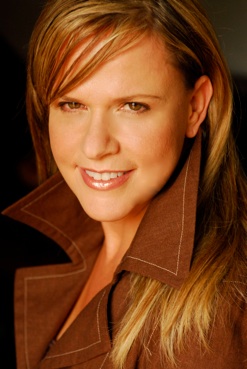
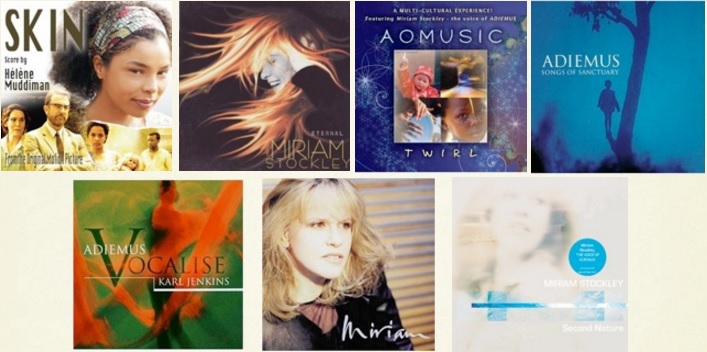
If I could borrow from myself, the metaphors classical, operatic, exotic and soulful may sound like an oxymoron but they all accurately describe the eclectic and wonderful world of Miriam Stockley. And yes, these words are in utter contradiction of one and another but that is the beauty of this adventurous singer from South Africa who continues to make strides into the mainstream market without compromising her unique signature voice.
While many of you might be more familiar with her collaborations with Karl Jenkins on the
Adiemus collections,
Miriam began to record her own solo material back in 1999 courtesy of her impressive debut simply titled Miriam. Since then she has gone on to release two additional impressive recordings that draw upon her eclectic musical background making her music challenging but utterly rewarding. Miriam is an artist of integrity who refuses to be restrained and restricted by one specific genre incorporating themes from classical, new age, world and jazz music.
Though it has been four years since her last solo endeavor Miriam continues to remain in demand with invitations to collaborate with other artists. As recent as 2009, Miriam co-wrote three songs and is vocally featured on the movie soundtrack
Skin which addresses the true story of a black child born in the 1950’s to white Afrikaners unaware of their black ancestry.
Despite her busy schedule Miriam found the time to discuss her past, present and future with Mainly Piano.
Q: Born in Johannesburg, South Africa, tell me a little about your cultural upbringing and how it has molded you as a person?
A: I was raised in a middle class white neighborhood in the midst of the Apartheid South Africa. As a very young child I spent a lot of time with my Bantu nanny, listening to her sing to me in her native Sotho. As a teen, I learned that music should bear no color discrimination & I made up my mind that I wanted to live in a country where I could work & live with people of all colors, religion & ethnicity.
Q: Moving to the UK in your teenage years must have been a difficult cultural transition. What prompted your move and how has this influenced your music?
A: I am actually British through naturalization - my father was born in England. I had spent many vacations in the UK and had lived in London for the better part of 1972. I had many relatives there and I loved the whole British pop music culture. As I stated earlier, I needed to make the move from South Africa for political and career reasons. African music was instilled in me from the time I was a baby, so it was no wonder that it popped up in my latter work.
Q: My first exposure to your unique musical voice came courtesy of the Adiemus debut Songs of Sanctuary but in actual fact you were prominently featured in the group Praise who released a self-titled album back in 1992. Tell us a little about this recording session and why such a theme?
A: Praise was purely a stage name with no religious connotation. I recorded a TV jingle for an Italian car (Fiat Tempra) in the early nineties and I used a brand new style of chant singing. The public began requesting the piece on radio and we (myself and my two writing partners) decided to make it into a single. It was later remixed by Andros Giorgio - George Michael's cousin - and it jumped straight into the British charts. We made an album and released a few more singles before our entire A&R department at Giant Records was made redundant - along with the project!
Q: With the exception of your two downloads on your website this disc appears to be difficult to find. Is this still readily available recording to your consumers?
A: Unfortunately, the album has been deleted. I was very proud of this project and I have always secretly hoped that Universal would re-release it.
Q: Three years later you found yourself recording Songs of Sanctuary which was the first of much collaboration with Welsh composer Karl Jenkins which was my first exposure to your very unique vocal delivery. Tell me how this musical partnership came about?
A: This too came about because of a commercial. I was called in to sing on a TV commercial for Jenkins Ratledge (Karl Jenkins and Mike Ratledge). It was for Delta Airlines. Strangely enough, the commercial nearly didn't happen, as it was originally recorded with a classical sounding choir and it was only when I introduced the African sounding kid's chorus, that the ad agency accepted the track. Once again, we were inundated with requests for the CD and we decided to make an entire album.
Q: Your last recording with Karl Jenkins was courtesy of Adiemus V back in 2001. Any plans of any future material with Karl or has the Adiemus series ran its course?
A: I've learned never to say 'never'. I felt that Adiemus had a great run, but that it was becoming a bit redundant. I wanted to branch out and use my vocals in different ways.
Q: 1999 represented the year of your solo debut album. After the huge success of Adiemus were you concerned about the expectation level?
A: There is always that niggle in the back of your mind, but I was ready to do something new and different. It was the right time for me to be moving forward.
Q: Two standout tracks on your debut album were “Uku’Lela” and “Homeland”. Tell me a little about the songwriting process?
A: “Uku L'ela” was co-written by me and a South African friend of mine (Glenn Keiles) who has extensive knowledge and experience working with ethnic African drums and percussion. “Homeland” was a three-way collaboration between me, Julia Taylor-Stanley who co-produced the album and Ian Lynn, a most wondrous and talented all round musician / arranger, who later worked closely with me on my next two solo albums. I wrote the melodies and the phonetics on both pieces.
Q: Three years later you followed up your debut album with Second Nature. Unfortunately, the copy in my possession is a promotional disc from the Narada label so I have no idea which tracks you wrote. The album showed further musical exploration best heard on the jazzy “Butterfly”. Why this particular song?
A: I co-wrote all the tracks on the album. “Butterfly” started out as a musical riff on the keyboard and expanded from there. I can be a very spontaneous writer and this piece almost wrote itself. The entire album was written about nature, the seasons and the elements. “Butterfly” (in my opinion) had to be depicted by the flute and Ian Lynn's and my love for Latin jazz was expressed on more than one track on the album.
Second Nature was originally made for the Japanese Healing Music market, but I was delighted that it crossed over into the New Age / Jazz market in the States. Quite a few of the tracks got picked up by Ben Smith - XM Satellite Radio's past Program Director of "Fine Tuning", which was an eclectic free form channel that crossed many borders. It was a melting pot of musical experiences from Rock to Jazz, Classical and World Music.
Q: In complete contrast there is the angelic “A Finish Summer Night”. Your rendition is breathtaking. The song has come in several different forms. Please share a little about its interesting background and what it means to you?
A: Thank you. I had always wanted to record an album of music written by the great composers (long before Eternal came out). “A Finnish Summer Night” was written by Sibelius, and I co-wrote the lyric with my husband Rod Houison - who has engineered on all of my recordings. This piece was one of the tunes that I loved as a young child and that I wanted to adapt for vocals. I often compare my music and the way I create in the studio to that of a painter and that is where the inspiration for the “Finnish Summer Night” lyric arose.
Q: Which brings us to your latest solo effort, Eternal, released back in 2006. It is without a doubt your most challenging solo recording to date. The classical influences here were much more prominent than your past endeavors. What inspired this approach?
A: This was a childhood dream of mine to one day sing all the wonderful tunes that had been introduced to me by my father, an avid fan of the Classics. I knew it was going to be challenging, as these pieces were not written for voice and they would require extensive adaptation - something that would not go down too well with the purists. I wanted to make one more album for my
Adiemus audience and what better way than to pay homage to the best of the best composers in Classical music history? In my opinion, music is an interpretation of one's thoughts and feelings and there is no right or wrong way to present a song. This was my musical interpretation of some of the greatest pieces ever written and I make no apologies for it.
Q: The album also included your sublime interpretation of the old Irish ballad “The Star Of County Down” that includes a more multi-layered but restrained vocal rendition and some gorgeous violin work. Fans of Enya and Secret Garden will simply fall in love with this song. That said what artists have influenced your body of material?
A: “Star of County Down” was the perfect vehicle in which to feature the hauntingly beautiful playing of Dermot Crehan - most known for his work on River Dance & Lord of the Rings. My influences are far from what people would expect. I was influenced by the likes of The Carpenters, Abba and Sergio Mendez. I loved anything featuring great vocal harmonization. I was not influenced by any of the New Age nor World Music artists of the day.
Q: In complete contrast there is the J.S. Bach composition “Nagana Ka Lona – Bourre” that also features a very festive percussion pattern which I am sure purists cringed over. In my humble opinion it is a very daring and adventurous arrangement. What was the general feedback on this song?
A: Luckily, I've only had positive feedback about it. I originally wanted it to appear as if it was sung totally a capela, by an African children's choir, but it was a bit staid that way. By adding in the percussion, I felt that it brought the track to life. I live dangerously and once again, I believe that music is meant to be interpreted.
Q: Eternal also included a tribute to your past courtesy of your own arrangement of “Adiemus”. What compelled you to look to the past and specifically this track?
A: “Adiemus” is one of my signature tracks and I wanted to re-record it in a slightly more modern way. It was originally a 30-second TV commercial which was stretched out and made into a three-minute piece of music. I wanted to re-sing the entire piece and own the recording.
Q: Though it has been four years since your last solo recording you have been very busy in multiple collaborations including your appearance on the 2009 AoMusic Twirl album. Is this a set group or a rotating project?
A: AoMusic - as it is now known is a group consisting of Jay Oliver, Richard Gannaway and myself. We are presently writing and recording material for the next AoMusic CD.
Q: Your most recent activity was on the Skin Original Motion Picture Soundtrack which shares the inspiring and intriguing true story of a black child born in the 1950’s to white Afrikaners unaware of their black ancestry. It appears that mainstream America may have missed this motion picture opportunity. Could you give our readers a little insight on both the movie and the music that accompanies it?
A: The movie Skin is based on a true and tragic story set in 1950's South Africa during the Apartheid era, when a mixed race child was born into a white Afrikaner family. I was approached by an English composer Helene Muddiman, to co-write some music for this movie. As I had firsthand knowledge of the language and the culture, I seemed to be an obvious choice for her. The movie has won so many awards. It was beautifully shot on location and I hope that people will get a chance to see it.
Q: With the start of a new decade and it being 4 years since you released your last solo effort, what can we expect from Miriam Stockley in the not too distant future?
A: I am enjoying doing a bit of everything at the moment. I have a few collaborative projects on the go and I would like to get more involved in the production side of the industry as well as recording. I have a couple of little things up my sleeve, but I am not in a huge hurry to get all of it out there.
The industry is reeling from the economic downturn and I'd like to see where it all settles before I release my next solo project.
Michael Debbage
May 2010