Reviews:

Ballerina (2006/2009)


Bio:

Always, he wanted to make something beautiful. Born in Kentucky, in 1974, Michael C. Bell spent his formative years in both Louisville and Murray. His dad’s beloved album collection was his earliest musical influence, comprised of Chicago, The Beatles, Jimmy Hendrix and soundtracks from “Superman” and the original “Star Wars.” “We always had an old upright piano and a guitar in the house,” writes Michael. “Seems like there was always music playing.” Michael’s father was also a musician and had been in a popular high school band in Louisville playing the legendary Hammond B3 organ. Michael writes, “My dad gave me my first and only piano lesson where he taught me to figure out music, not by reading notes on the page, but by referring to the guitar chords above the staff of piano music.”
At 12, Michael composed his first piano piece. “I put my hands on the piano and felt the keys. I felt like if I just started to press the keys that the music would start. That it would just come to me,” writes Michael.
Playing in the wind ensemble at school, Michael wasn’t happy making just piano music, and began constructing “multi-track” pieces at home using a poor man’s recording trick. First, he’d record a single instrument onto cassette, then, while playing a second instrument to the recorded cassette, he’d record that onto a second cassette, and repeat as needed. “As a teenager,” Michael writes, “I didn’t have access to real recording gear and certainly didn’t have the money to buy it myself. It was exciting for me to get to hear my multi-track creations, even though the sound quality, after a few tracks, was pretty horrible. But, at the time, I didn’t care.”
A fan of the musician Wynton Marsalis, Michael heard in band one day of a place where music was no longer about written notes on a page, but that some musicians, like Marsalis, could reach a transcendent point where to play “C” no longer meant they had to think “C” and it’s fingerings because they no longer needed to translate music from the head to the body. This would become Michael’s watershed, emboldening him to believe he could be a composer. He developed the habit of playing piano in the dark and feeling his way across the keys, finding the music without the distraction of finger placement or chord structure, improvising to a mood or feeling, turning lights on only to see where his fingers landed when he found a particularly interesting combination of notes. He began scoring his own music to favorite scenes from movies, as if playing along in the darkened theatre.
The senior class was putting on a short play about “Beowulf.” A senior himself, Michael volunteered to score the play, composing a piece for wind ensemble, “Saltatio Cum Obscuritatae” (Dance with Darkness). Because the piece was too difficult for the High School band to play, his English teacher put in a call to Murray State University to ask for their assistance and the university agreed to play Michael’s piece and record it. They scheduled a time for Michael to bring in the music. Michael writes, “I was sitting in the auditorium when they played my piece, and it was the single most wonderful and terrifying moment of my young life. It went from my head to paper and then I heard it performed. It was the first time I heard it out loud.” Unfortunately, there’d been a mix up with the recording and the cassette Michael went home with was blank. He never got to share it with the senior class, and never heard the piece again.
However, that same year, Michael got the chance to intern with a local studio owner, Mike Burnham. Mike had a studio in his home and quickly put Michael to work, not composing, or laying tracks, but forcing him to play to a metronome, over and over again. “Mike didn’t just let me skate by on talent alone, he was teaching me the trade and I will forever be grateful to Mike for taking me in and showing me the ropes in the studio. It was such an unselfish thing for him to do. He introduced me to a whole new world of possibilities and methods for getting my music out for others to hear.”
Michael longed to write scores for film and have his music played again by live musicians. The cassette recordings he could generate from home were only shadows of what he heard in his mind, losing clarity and color with every generation recorded. These demos didn’t open doors for him as a composer, but the constant jimmying with technology over music revealed a different set of aptitudes which he could develop anywhere.
Over the next several years, there would be spurts of writing, and a few failed attempts to finish a complete instrumental CD. He had a wife, a full time job, and three young children. Money was tight and couldn’t make the time commitment recording an entire CD required. It wasn’t until the children got a little older and Michael and his family settled in North Georgia that inspiration struck. Michael writes, “I had always suffered from mild insomnia and was searching for music I could go to sleep to. The frustrating part for me was finding that balance of music that was pleasing to listen to, but wouldn't wake me up. At a certain point, I stopped looking and thought, I’ll just write the music myself.”
It would be eight months of writing and editing before ’In the Stillness’ was completed. “Half the time,” writes Michael, “I was literally in my bedroom closet. We were in a tiny apartment, all five of us, and there simply wasn’t room for my studio, so I did what any respectable musician would do in that situation . . . I went into the closet.”
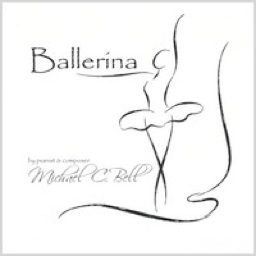
In 2006, “In the Stillness” was completed with six piano tracks and four orchestra tracks. Michael reverbed everything and mastered it himself, but never felt like the final product represented what he heard in his head. In 2009, Michael was about to begin work on his second CD, and chalk ”In the Stillness” up as a learning experience. He poured over the many listener responses and wondered if he had done enough to bring the music he heard to them, if it was worthy of their precious time and attention. And so, he elected to have “In the Stillness” professionally engineered and mastered, and “Ballerina” was born. Poised and graceful. Balanced and self-possessed. Seasoned as a prima ballerina assoluta.